The work that has to happen before AI works
Off-the-shelf models know the internet. They do not know your policies, your products, your pricing rules, or the years of decisions that make an answer correct rather than merely plausible. This is the step almost everybody skips, and it is the one that decides whether anything built afterwards survives contact with a real question.
of agentic projects are expected to be scrapped by 2027.
of pilots never reach production.
of three-year total cost of ownership is operations, not the build.
The model was never the problem
Almost every stalled AI programme is diagnosed as a model problem, a prompt problem, or a vendor problem. It is usually none of those. The model is fine. It simply has nothing of yours to reason over.
What an organisation uniquely knows tends to sit in the worst possible shape for this: scattered across drives and inboxes, locked in PDFs and screenshots, contradicted by a newer version nobody linked to, and governed by rules that exist only in somebody's head.
This work is the precursor to AI capability, not a parallel track to it. Get the knowledge into governed, retrievable infrastructure and the capabilities become straightforward. Skip it and you are buying demos.
You will recognise at least two of these
You have bought AI tools that know nothing about you
Licences are deployed, adoption is flat, and the honest answer from staff is that it is faster to ask a colleague.
A pilot went well and then went nowhere
The demo answered beautifully. Production asked harder questions, the answers drifted, and nobody could say why.
You have a list of proposed agents and no way to triage it
Every department has an idea. Some are justified, some are already solved by software you own, and some are category errors. Nobody can tell which without a method.
Security or compliance stopped it
The question was what the thing can reach, who it acts as, and what evidence exists afterwards. There were no good answers, so it stopped.
Your knowledge is real but unusable
Decades of expertise in documents no system can read, no freshness rules, and no way to tell a current policy from a superseded one.
What you receive
The diagnostic. It establishes what your organisation actually knows, whether that knowledge can support an answer someone would act on, and what would have to be true before any AI capability is worth building.
- Price
- £2,999 fixed
- Duration
- 4 to 5 days
- Commitment after
- None
- A knowledge inventory. Where your organisation's knowledge actually lives, who owns it, what condition it is in, and which sources contradict each other. For most organisations this is the first time it has been seen in one place.
- A usability assessment against real questions. We take questions your people genuinely ask and establish whether a correct, current, citable answer can be retrieved at all. Where it cannot, we say precisely why.
- A governed retrieval plan. Source scope, access boundaries, citation rules, freshness checks and escalation points, so an answer can be trusted and traced rather than merely produced.
- A capability recommendation, including where the honest answer is not yet. Which proposed AI capabilities the knowledge you hold can actually support, which are already delivered by software you own, and which are category errors.
- A control model. Identity modes, policy enforcement, approval mechanics and audit, written so your security and compliance functions can assess it without a translation layer.
- An eval set. Fixed questions with known-correct sources, so quality is measurable on day one and regression is detected by you rather than by a customer.
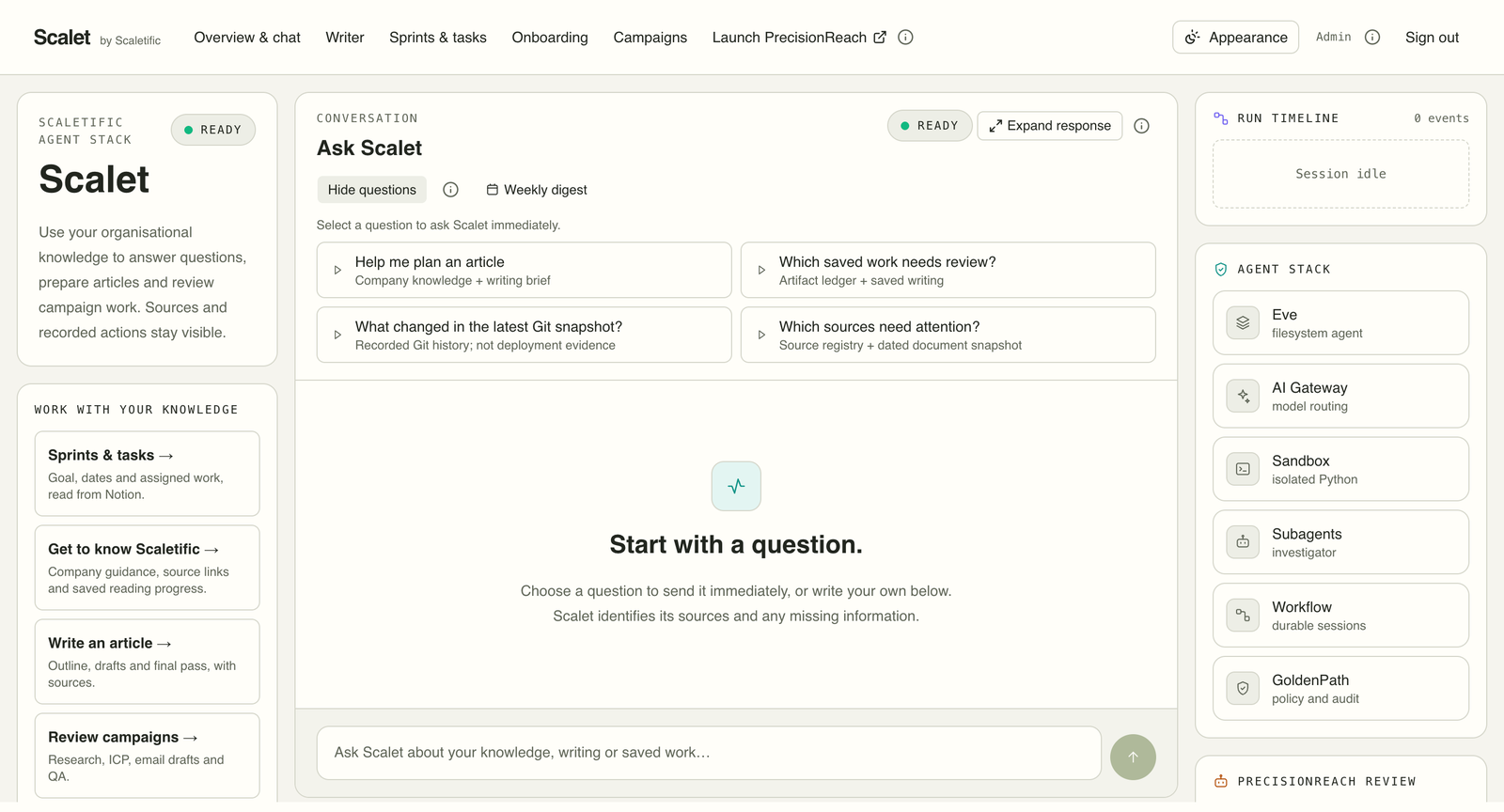
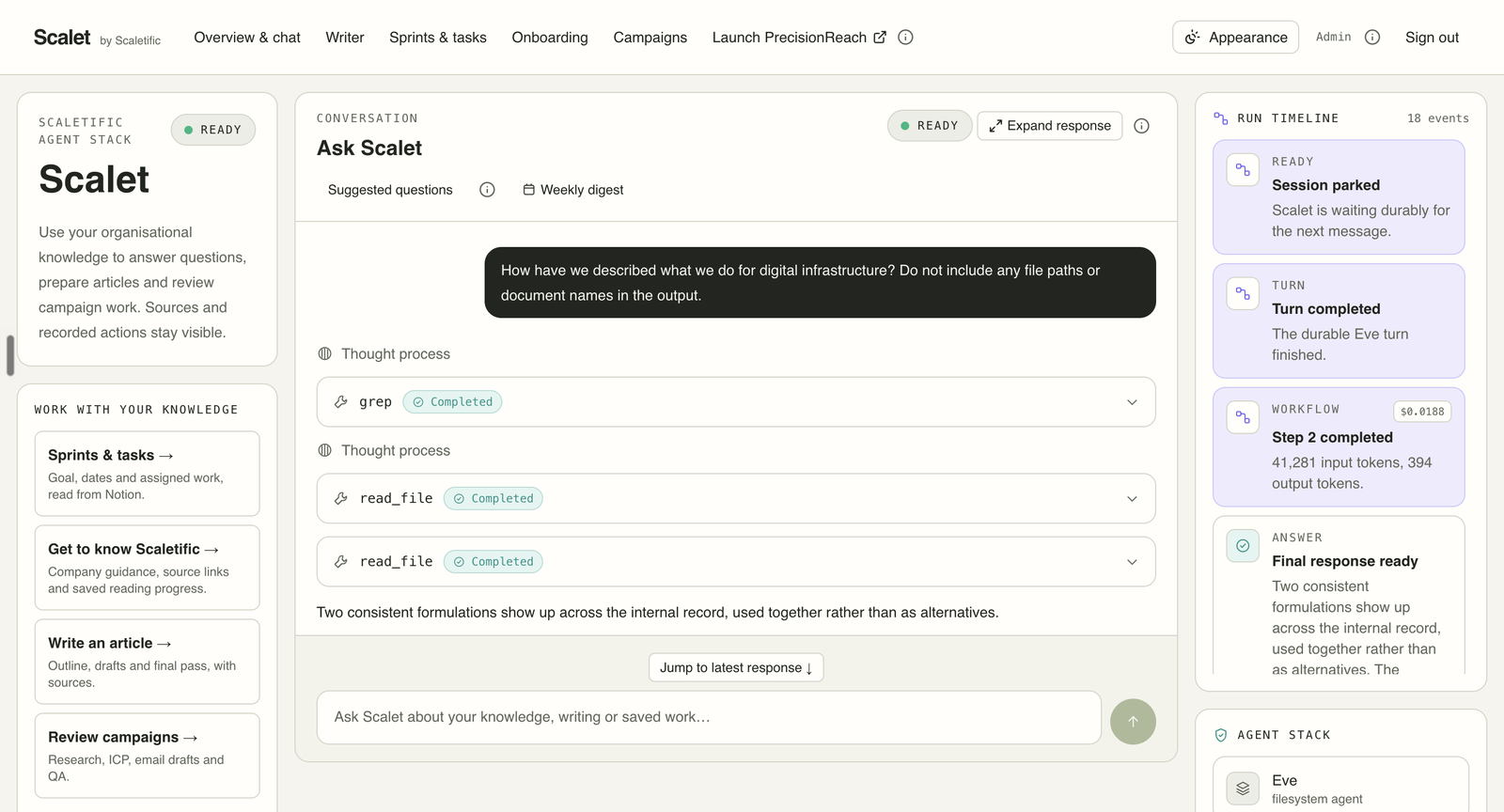
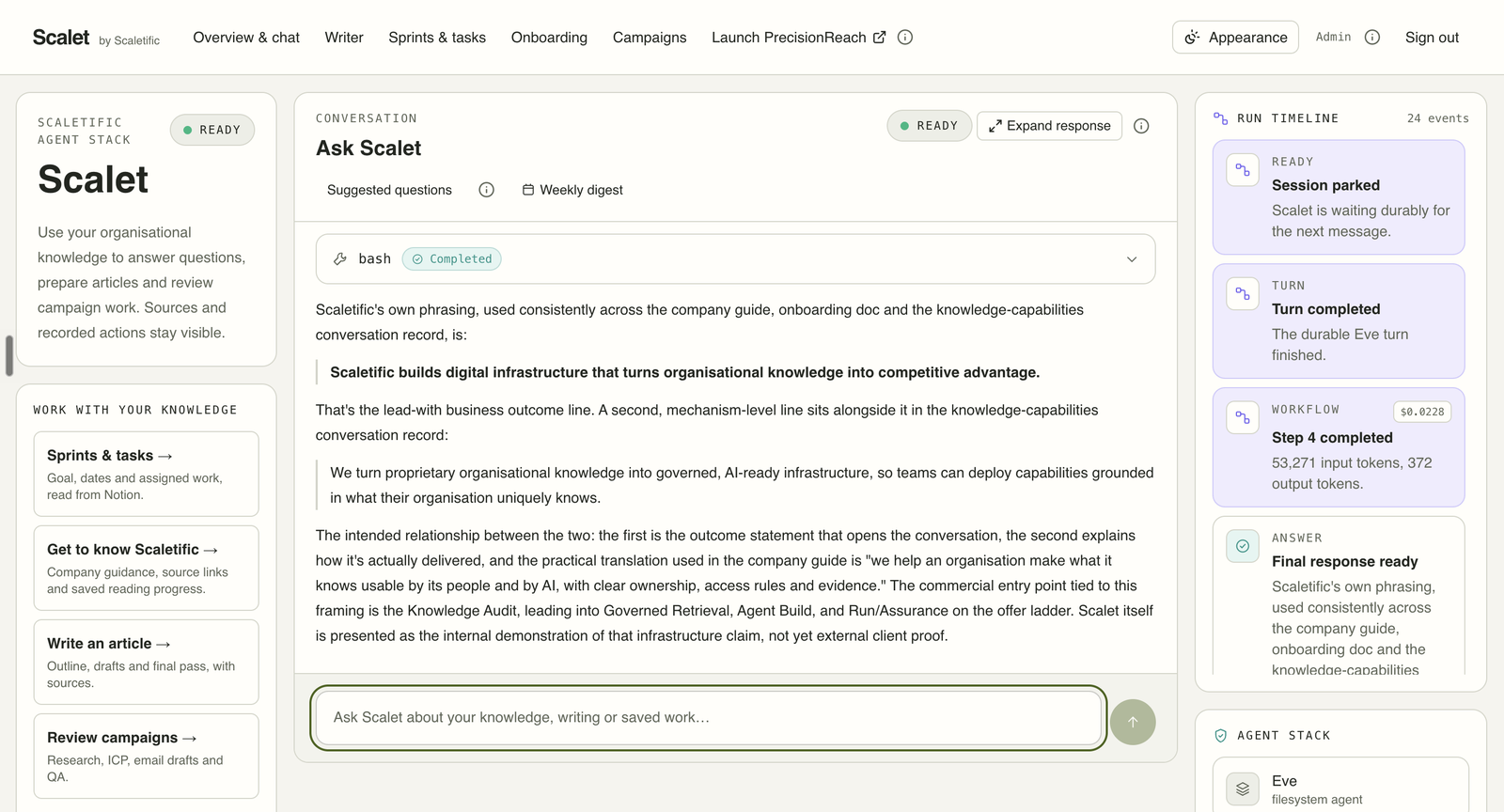
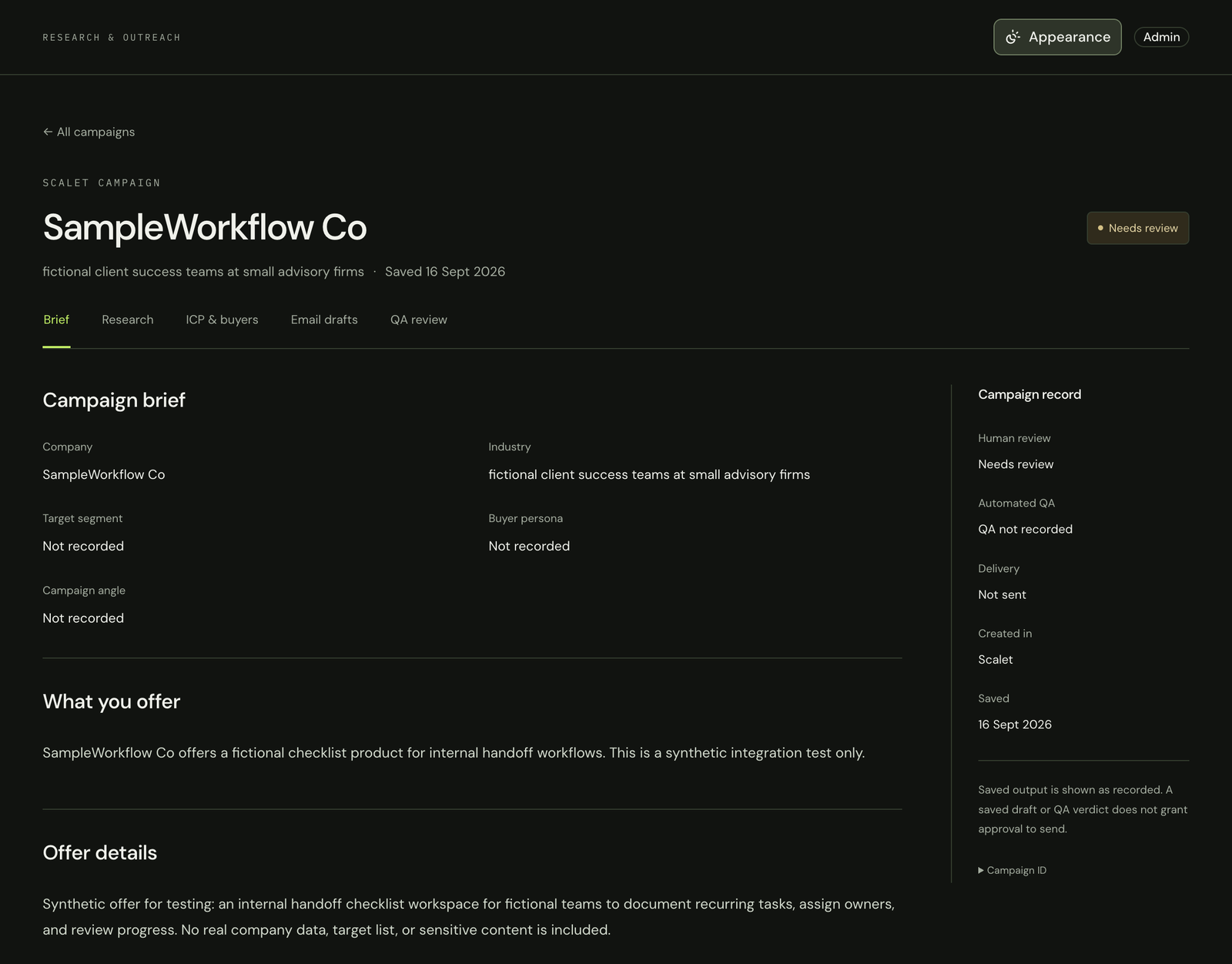
An answer you can check, not one you have to trust
This is our own workspace, running against our own company knowledge. It is the shape of the thing the audit tells you whether your organisation can support.
A method, not a workshop
The audit is deliberately diagnostic. We are not there to agree that AI is important, or to produce a strategy deck. We are there to establish which of your proposed capabilities are justified, what they would need to reach, and whether the knowledge behind them is in any state to support an answer you would stand behind.
That means going through your actual corpus rather than talking about it. Where the sources are, what shape they are in, which of them contradict each other, what has no owner, and what would have to be true for a retrieved answer to be trustworthy.
You end with a decision you can defend to whoever has to sign it off, and a plan detailed enough to build from.
Nothing obliges you to continue
The audit is a fixed-price piece of work that stands on its own. If you take the plan to another supplier, or build it yourself, it is written to be usable by anyone competent. If you would rather we built it, this is what that looks like.
02 · Build
From £9,000One agent, built against the control model the audit produced. Single-tenant, deployed, and defensible to whoever has to sign it off.
Per agent
03 · Run
£5,000Operations are 65 to 75% of three-year total cost of ownership. An agent nobody maintains drifts quietly, and the first sign is usually a wrong answer in front of someone who matters.
Per month, model cost passed through
What it unlocks
Governed knowledge infrastructure is not the destination. It is the thing that makes the destination reachable.
Once it is structured and governed, your team stops waiting for software. They compose what they need against what the organisation already knows, keep it if it earns its place, and discard it if it does not, without anyone having commissioned anything to find out.
That is not only for engineers. The same governed foundation serves an administrator building something to handle a recurring request and a principal engineer wiring an agent into delivery. Both are drawing on the same knowledge, under the same controls, with the same guarantees about where an answer came from.